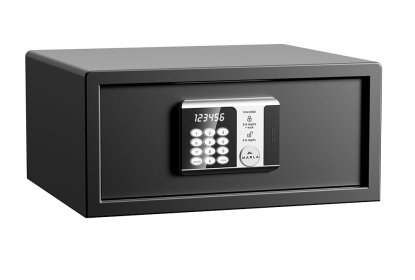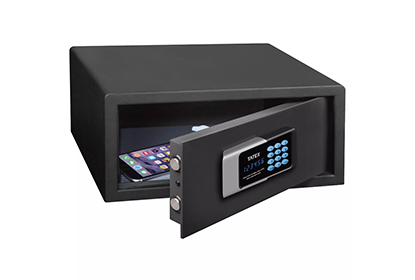
Drawer-type safes and standard safes offer different placement options among electronic safe solutions commonly used in hotel rooms. The main difference between these two safe formats is related to how the safe is positioned within the furniture, how the door or body becomes accessible, the dimensions of the available space, and the intended use scenario.
For this reason, when comparing a drawer-type hotel safe with a standard-size hotel safe, it is important to consider not only the external appearance of the safe but also the hotel furniture in which it will be installed and the overall room layout.
It should also be kept in mind that neither the drawer-type nor the standard form alone determines the security level of a safe. Security should instead be evaluated together with the body construction, locking system, fixing method, and the technical specifications of the relevant model.
| Feature | Drawer-Type Safe | Standard Safe |
|---|---|---|
| Placement | Can be planned according to a drawer-like space within the furniture | Can be positioned in a suitable compartment within the furniture |
| Access Method | May vary depending on designs providing access from the top or front | Provides access according to the door and body design of the model |
| Furniture Compatibility | May need to be designed together with the drawer structure | Can be placed inside a dedicated cabinet or compartment |
| Dimensions | Can be considered for hotel furniture suitable for a drawer-type form | The external dimensions of the safe are compared with the installation area |
| Use Scenario | Can be considered for hotel furniture suitable for drawer-type placement | Can be used in different cabinet and furniture layouts |
As the name suggests, a drawer-type safe can be evaluated according to a drawer-like placement concept within the furniture. For this reason, the internal structure of the furniture and the available installation area become particularly important.
For example, in a built-in furniture safe application, the width, height, and depth of the section where the safe will be installed should be checked in advance. In drawer-type models, not only the external dimensions of the safe but also the drawer structure of the furniture must be compatible with the safe.
Standard safe models, on the other hand, may be positioned in a separate compartment within the existing furniture. In this case, the main consideration is ensuring that the dimensions of the safe are compatible with the available installation area.
Therefore, in hotel furniture safe applications, the placement decision should be evaluated primarily according to the furniture design and available space rather than solely according to the form of the safe.
The physical dimensions of a safe are directly related to its intended use. For a hotel safe, knowing only the external dimensions may not always be sufficient. Internal volume, door or drawer movement, and the installation space required within the furniture should also be taken into consideration.
If the approximate dimensions of the items intended to be stored inside the safe are determined in advance, a more accurate assessment of the usable internal volume can be made.
When choosing between a standard-size safe and a drawer-type model, the decision should therefore not be based solely on external dimensions. Particularly in drawer-type electronic safe models, the internal volume and external dimensions may need to be evaluated separately.
In addition, the usable interior space may vary depending on the design of the body and electronic mechanism. For this reason, checking the internal dimensions in addition to the external dimensions specified by the manufacturer can help prevent possible compatibility issues before installation.
When determining the type of safe to be used in a hotel room, the existing room and furniture layout should be taken into consideration. The objective should not be to standardize one specific safe format for all hotel rooms, but rather to create a solution that is compatible with the existing furniture design.
Drawer-type hotel safe models can be considered in projects where drawer-style placement can be integrated into the furniture design. In top-opening drawer-type safe designs, the space required for the opening movement of the safe should also be calculated together with the furniture layout.
Standard hotel electronic safes can be considered in furniture designs where a separate compartment is available for the safe. In this case, the compatibility between the installation area and the safe dimensions should also be checked in advance.
The position of the compartment allocated for the safe within the room, its distance from other furniture elements, and the movement area required for the door or drawer should all be evaluated together when determining the appropriate model.
Electronic safe models are available in both drawer-type and standard forms. Therefore, the presence of an electronic system does not necessarily mean that the safe must have a specific placement format.
In drawer-type electronic safe models, the electronic locking mechanism can be designed together with the drawer-shaped body. In standard electronic safe models, the electronic locking system is integrated into the door and body structure of the safe.
Electronic features may vary from one model to another in both formats. When evaluating features such as digital code operation, display design, power supply, and other electronic functions, the technical documentation of the relevant product should be taken as the primary reference.
The important point is that neither the electronic features nor the safe format alone determine the level of security. When evaluating a model intended to be used as a hotel safe or in-room safe, the body structure, locking system, fixing method, and technical specifications provided by the manufacturer should all be considered together.
Can a drawer-type safe be added to existing furniture later?
This depends on the design of the safe and the structure of the existing furniture. If a drawer-type model is planned to be added later, the internal dimensions of the furniture, load-bearing structure, fixing points, and installation requirements of the safe should be checked in advance.
Is the rail system important in a drawer-type safe?
Yes. In models where the drawer movement operates through a rail mechanism, the rail system should be compatible with the design of the safe.
Can a drawer-type safe have internal storage space?
Yes. Drawer-type safes can have an internal compartment where items can be stored. However, the usable internal volume may differ from the external dimensions of the safe and can vary depending on the body structure and mechanism.
Should the safe dimensions be checked before installation?
Yes. The external dimensions of the safe, the installation area, fixing points, and the space required for opening or pulling movements, where applicable, should all be checked before installation.