Most hotel owners walk into a minibar purchase asking what it costs.
We've been producing minibars in Istanbul since 1954. Three generations. Still the only Turkish factory that runs absorption, thermoelectric, and inverter compressor minibar under one roof.
A minibar that costs €50 less up front can cost €600 more in electricity over its lifetime.
The cooling principle is the part you can't fix later. An absorption unit doesn't become a compressor unit because you paid for the premium model. A peltier minibar doesn't suddenly handle hot rooms because you spent more. The technology is the most important thing while choosing your minibar.
Absorption. No moving parts. An ammonia-water-hydrogen loop heated by an electric element does the cooling. It works zero decibels without any vibration.
The catch is heat and electricity. Above 35°C ambient, efficiency falls off. Daily consumption sits around 0.9 kWh per unit. Cooling depth is around at 8–10°C.
Thermoelectric. The peltier module effect. Current between two semiconductors, one side cools, one side heats. Most peltier units on the market run a small fan to move air. We do not use fans in our thermoelectric minibars. We engineered our thermoelectric condenser fanless, passive heat sink, no moving parts at all. Elektromarla peltier minibar works 0 dB like absorption, while a fanned peltier works at 25–32 dB. Most buyers don't know this design split exists.
Daily consumption around 0.6 kWh per unit.
But peltier cools 20°C below ambient and that's the trouble. Room at 28°C means cabinet at 8°C. Capacity is around at 20–40 liters. It's suitable for city-hotel and design-hotel technology. We do not recommend for resorts with hot climate environments.
Inverter compressor. Conventional refrigeration is improved by Elektromarla with the smart inverter card. The compressor modulates speed continuously instead of working on and off. Runs fasterwhen the cabinet's warm, drops to roughly 1,200 RPM near temperature and goes nearly silent. The only technology that holds performance in Antalya in August or Dubai or Saudi Arabia.
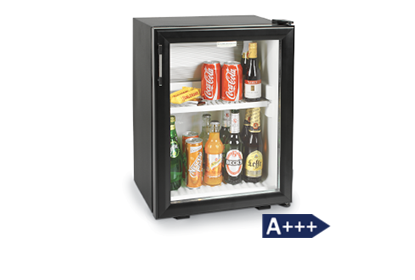
Here's the part that surprises buyers when they see our test sheets: daily consumption around 0.15 kWh per unit. This is almost one sixth of what absorption minibar consumers and a quarter of a peltier. Inverter card lets the compressor idle most of the day instead of cycling on full power as on/ off. You get the deepest cooling, widest capacity range (40–100L), and on inverter models with A++ to A+++ energy ratings. The only disadvantage is 22–28 dB noise it makes which takes only 8 seconds thanks to the inverter technology. The non-inverter compressors works around the market around three times the electricity of an inverter and cycle much more.
| Absorption | Thermoelectric (fanless) | Inverter Compressor | |
|---|---|---|---|
| Noise (dB) | 0 | 0 | 22-28 |
| Daily energy (kWh) | 0.9 | 0.6 | 0.15 |
| Annual energy (kWh) | ~328 | ~219 | ~55 |
| Lifespan (years) | 10–15 | 8–12 | 8–12 |
| Capacity (L) | 30–60 | 20–40 | 40–100 |
| Hot-climate tolerance | Low | Low | High |
Ambient room temperature is the most crucial effect. If the air conditioner running 24/7 in the whole hotel , all three technologies are fine.
If the ambient temperature exceeds 35°C, you MUST pick the inverter compressor minibar. I once watched a resort owner near Bodrum order 80 absorption units because they were "the silent ones." By August half the rooms had complaints because of poor performance. They were getting complaints that the minibar was not cooling. The minibars are actually cooling but the environment
Certifications are PDF or they don't exist. CE, RoHS, EAC for Eurasian markets, Energy Label, ISO 9001 from the manufacturer prepared by reputable companies like TÜV, Intertek or SGS.
A 100-room hotel paying €0.15/kWh, roughly the EU industrial average, looks like this annually based on our own test data:
| Technology | Daily kWh | Annual kWh/room | 100 rooms (kWh) | Annual cost |
|---|---|---|---|---|
| Absorption | 0.9 | 328 | 32,850 | €4,927 |
| Thermoelectric (fanless) | 0.6 | 219 | 21,900 | €3,285 |
| Inverter compressor | 0.15 | 55 | 5,475 | €821 |
The inverter minibars costs roughly €820 a year to run. The absorption minibars costs €4,900. That's a €4,100 annual gap on a 100-room property, €41,000 over a decade.
| Hotel | Technology | Capacity | Why |
|---|---|---|---|
| Boutique & luxury (5⭐) | Absorption / Thermoelectric (fanless) | 30–40L | True 0 dB silence |
| Business city (4⭐) | Inverter compressor | 40–50L | Performance + lowest energy |
| Beach resort | Inverter compressor | 40–60L | Heat tolerance |
| All-inclusive | Inverter compressor | 30–60L | Capacity + cost |
| Eco-certified | Thermoelectric (fanless) | 30–40L | No F-gases, 0 dB |
As Elektromarla Minibar, we are Turkey’s leading minibar producer.
2–4 weeks lead time vs. 8–16 weeks plus customs if you decide to buy overseas.
Local spare parts are always ready and we have 7/24 customer support.
We export to 25+ countries across the Balkans, North Africa, Caucasus, Middle East, Central Asia, and Eastern Europe. Catalog at elektromarla.eu.
Worth reading next: